




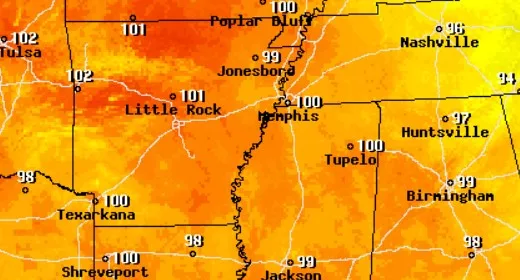
North Little Rock, AR — With dangerously high temperatures expected in the coming weeks, the Arkansas Division of Emergency Management (ADEM) urges Arkansans to take precautions to reduce the risk of heat overexposure.
ADEM, an Arkansas Department of Public Safety division, recommends getting educated on watches and warnings.
Excessive Heat Watch
Forecasters expect a prolonged period (2-to-3 days) of exceedingly hot and humid weather conditions.
Heat Advisory
Issued within 12 hours before dangerous heat conditions are expected. Daytime heat indices of 100ºF–104ºF for two or more hours. The heat index is a measure of how hot it feels when relative humidity is factored in with air temperature.
Excessive Heat Warning
Daytime heat indices of greater than or equal to 105°F for two or more hours.
Extreme heat can be hazardous – even life-threatening – if people do not take precautions to maintain a normal body temperature. Some individuals are at a greater risk of heat overexposure than others, such as children, the elderly, and those who are disabled or have medical conditions. No one is immune, however. Monitoring yourself and others for signs and symptoms of heat-related illnesses is important.
Heat-related Illnesses include:
HEAT CRAMPS are muscular pains and spasms caused by heavy sweating that usually occur in the legs or abdomen. Get the affected person to rest in a comfortable position in a cooler place. Give them water or fluids with electrolytes to help them rehydrate.
HEAT EXHAUSTION occurs when people overexert themselves in a warm, humid place, often affecting those doing strenuous work in hot weather. Body fluids are lost through heavy sweating, and blood flow to the skin increases, which causes the blood flow to vital organs to decrease. This results in a form of mild shock.
Heat exhaustion symptoms include cool, moist, pale, or flushed skin, nausea, dizziness, headache, weakness, and/or exhaustion.
Treat it by helping the affected person rest in a comfortable position in a cooler place. Remove or loosen tight clothing and apply cool, wet cloths (such as towels or sheets). If the person is conscious, give them half a glass of cool water or fluids with electrolytes every 15 minutes, ensuring they drink slowly. Watch them carefully for changes in their condition and call 9-1-1 if it doesn’t improve.
HEAT STROKE is the most serious heat emergency and is life-threatening. It develops when systems in the body begin to stop functioning due to extreme heat. Heat stroke may cause brain damage or death if the body is not cooled quickly.
Symptoms include extremely high body temperature, hot and red skin (dry or moist), loss of consciousness, changes in the level of responsiveness, rapid and weak pulse, rapid and shallow breathing, vomiting, confusion, and/or seizures. Someone suffering from heat stroke needs immediate assistance.
Call 9-1-1 and move the person to a cooler place. Immerse the individual in a cool bath, wrap in cold, wet sheets, or cover the person in bags of ice if possible.
During times of extreme heat, it is important to:
- Stay indoors as much as possible and limit exposure to the sun.
- Do not leave pets outside for extended periods.
- Find air conditioning, if possible.
- Check on family members and neighbors – especially those without air conditioning.
- Avoid strenuous activities.
- Watch for signs and symptoms of heat-related illness (such as heat cramps, heat exhaustion, and heat stroke).
- Wear light-colored, loose-fitting, and lightweight clothing.
- If you must be outdoors, limit your outdoor activity to the morning and evening hours.
- Try to rest often in shady areas so your body temperature will have a chance to recover.
- Use sunscreen with a high SPF and wear a wide-brimmed hat.
- Drink plenty of water even if you aren’t thirsty. (Avoid drinks containing alcohol and high amounts of sugar and caffeine.) Make sure that pets have access to water.
- Eat regular meals that are well-balanced and light.
- Never leave people or pets in a closed car, even with open windows.
For more information from FEMA about managing extreme heat: Extreme Heat (fema.gov)
Have a news tip or event to promote? Email White River Now at news@whiterivernow.com. Be sure to like and follow us on Facebook and Twitter. And don’t forget to download the White River Now mobile app from the Google Play Store or the Apple App Store.
Get up-to-date local and regional news/weather from the First Community Bank Newsroom on Arkansas 103.3 KWOZ every weekday morning and afternoon. White River Now updates are also aired on weekday mornings on 93 KZLE, Outlaw 106.5, and Your FM 99.5.