



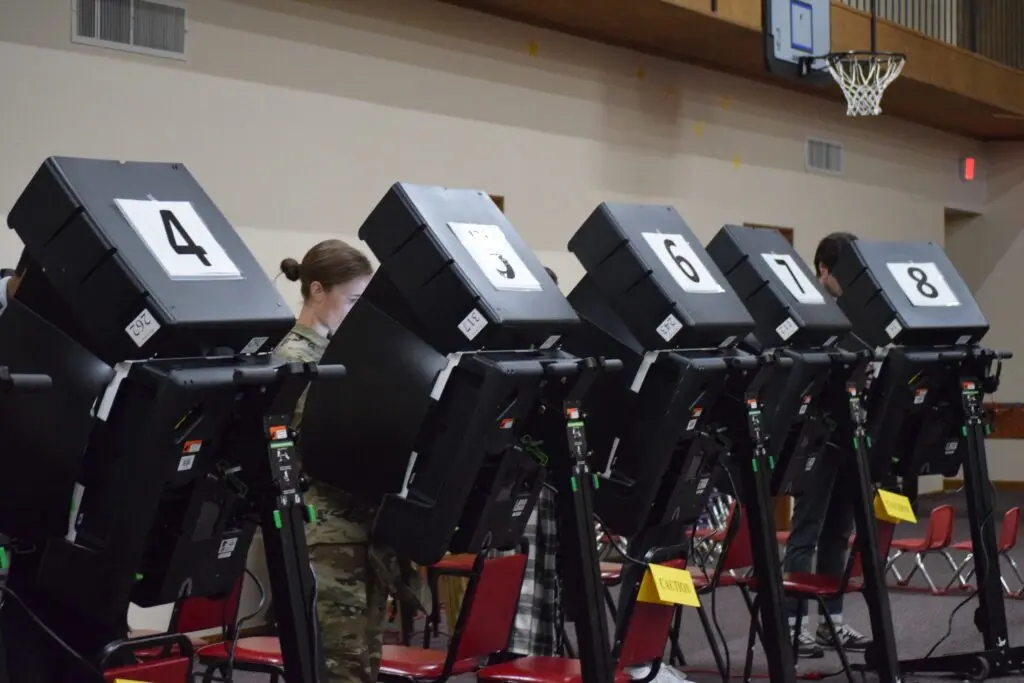
Voters cast their ballots at Sang Avenue Baptist Church in Fayetteville on Nov. 5, 2024, Election Day. (Photo by Antoinette Grajeda/Arkansas Advocate)
A new rule prohibits registered Democrats from voting in GOP primaries
By Antoinette Grajeda, Arkansas Advocate
The 2026 election cycle marks the first time a new Republican Party of Arkansas rule prohibiting registered Democrats from voting in GOP primary races will be enforced.
The new rule has an impact in a state where Republicans hold every statewide partisan office, every seat in the congressional delegation and a majority in both chambers of the Legislature.
This spring’s primary election features contested Republican primaries for several races, including U.S. Senate, secretary of state and some high-profile state legislative seats. The primary election is March 3 and the general election is Nov. 3.
Here’s what to know about the rule change:
Who can participate in primary elections?
Arkansas’ preferential primary elections have been open, meaning voters can choose if they want to vote a ballot with Republican candidates or one with Democrat candidates, regardless of the voters’ registered party affiliation.
That changed when the Republican Party of Arkansas voted at its state committee meeting in June to approve a new rule that prohibits registered Democrats from voting in Republican primaries.
What does the new GOP rule say?
“Qualified electors shall NOT be a registered Democrat before being issued a Republican primary ballot to vote in a Republican party primary election,” according to the updated party rules.
Republican Party of Arkansas Chairman Joseph Wood said the purpose of the rule is to prevent voters registered as Democrats from participating in Republican primary elections.
Who suggested the rule?
Republican Sen. Joshua Bryant of Rogers presented the rule. Having experienced open and closed primaries living in different states, Bryant said he can see both sides and didn’t really have a stance on the issue. However, he suggested the rule in response to some “endfighting” in the party over closing primaries.
Proponents of closed primaries are often concerned about voters changing their party affiliation to sway the results of the opposing party’s race, which could happen in races decided by a handful of votes, Bryant said.
The GOP’s new rule makes the party’s primaries “semi-closed,” he said, because there are still ways for voters who aren’t registered Republicans to vote in Republican primaries.
“If you are convicted in your policy beliefs to be a registered Democrat, then stay as a registered Democrat, don’t vote in Republican primaries,” Bryant said. “Otherwise remove your registration to Optional or Republican or Libertarian and then come on over.”
However, Bryant said the Democrat and Republican platforms are different enough that if someone wants to “wear that banner” as a registered Democrat, they should “just stay in your lane.”
Do Democrats have the same rule?
Democrat primaries remain open, and anyone can participate, Democratic Party of Arkansas Communications Director Micah Wallace said.
“Any voters that wish to participate in the Democratic primary are welcome to do so,” Wallace said. “We didn’t close our primary because there’s no reason to. We want to invite more voters to participate in the Democratic primary.”
Wallace said the new Republican primary rule makes voting appear more inaccessible in a state that already has low voter participation.
“While this does virtue-signal how exclusive and cliqueish the Arkansas GOP is, it doesn’t actually prevent many Democrats from participating in the Republican primary if they are determined to do so,” she said.
Do I have to pick a party?
Arkansans are not required to select a party affiliation when they register to vote. Arkansas voters can register as an Independent (Party Optional). Independents can choose whether they want to vote in Republican or Democrat primaries. Or they can choose to vote only in the non-partisan judicial elections March 3.
Nearly 87% of registered voters have their party listed as Optional, according to the secretary of state’s office.
Can I switch party affiliations?
Yes. You can change your party affiliation prior to the election by contacting your local county clerk or at the polls on Election Day.
Chris Powell, the secretary of state’s director of public affairs, said his office doesn’t see a lot of voters switch party affiliations around election time, and they have not noticed an unusual number of changes ahead of the March primary.
What happens if there’s a runoff in the primary?
If you choose to vote in a Republican primary election, you can’t vote in a Democrat primary runoff, and vice versa. There’s no “crossover voting” between a primary and a runoff, Powell said.
Who’s eligible to vote in the March 3 primary?
Arkansans must be registered to vote by Feb. 2 to be eligible to cast a ballot in the March 3 preferential primary election and the nonpartisan judicial election. State law requires you to present a photo ID to vote.
Details about how to register to vote are available on the secretary of state’s website.
The Arkansas Advocate is a nonprofit, nonpartisan news organization dedicated to tough, fair daily reporting and investigative journalism that holds public officials accountable and focuses on the relationship between the lives of Arkansans and public policy.
Have a news tip or event to promote? Email White River Now at news@whiterivernow.com. Be sure to like and follow us on Facebook and Twitter. And don’t forget to download the White River Now mobile app from the Google Play Store or the Apple App Store.
Get up-to-date local and regional news/weather from the First Community Bank Newsroom on Arkansas 103.3 KWOZ every weekday morning and afternoon. White River Now updates are also aired on weekday mornings on 93 KZLE, Outlaw 106.5, and Your FM 99.5. Catch CBS News around the top of every hour on 1340 KBTA.