
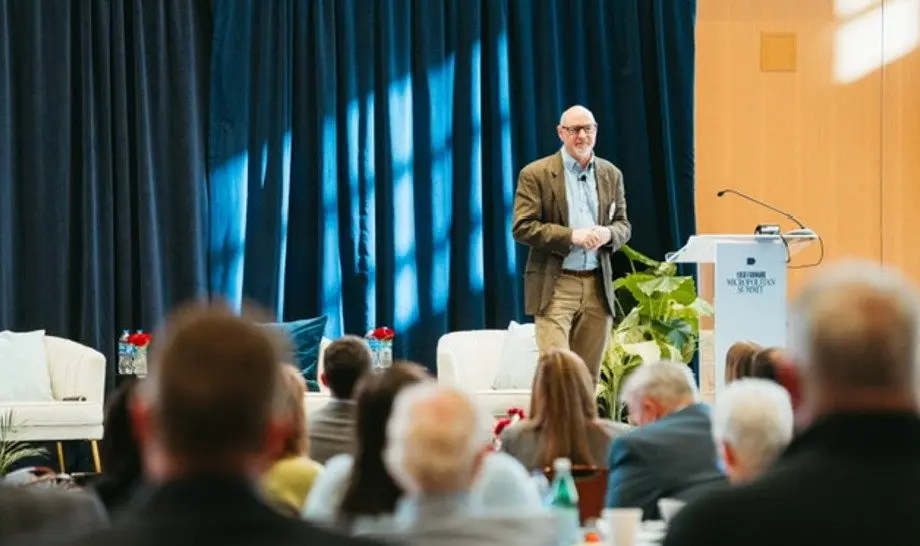
Dr. Scott Roulier, John Trimble Sr. Professor of Political Philosophy at Lyon College, delivers the keynote address at the recent 2026 National Micropolitan Summit at Oklahoma State University in Stillwater, Oklahoma. (Image provided by Lyon College.)
Dr. Scott Roulier of Batesville, the John Trimble Sr. Professor of Political Philosophy at Lyon College, delivered the keynote address at the 2026 National Micropolitan Summit recently on the campus of Oklahoma State University in Stillwater, Oklahoma.
Roulier spoke in his role as co-director of the Thriving Cities Lab at the University of Virginia’s Institute for Advanced Studies in Culture. He was joined for the keynote session by Dr. Ty Buckman, the lab’s co-director and institute director.
The summit was sponsored by the George Kaiser Family Foundation and 1050 Forward, an Oklahoma nonprofit focused on strengthening small and mid-sized communities. Attendees included state and federal officials, civic leaders from cities across Oklahoma, and representatives of foundations and nonprofits from around the country that focus on small and mid-sized urban areas.
“It has been a great privilege to partner with 1050 Forward and to collaborate with their committed and talented fellows — community leadership teams — to make improvements in various dimensions of civic life in Muskogee and Stillwater,” Roulier said.
According to the U.S. Census Bureau, a micropolitan area is an urban cluster with a population between 10,000 and 49,000 residents. Nearly 48 million people in the United States live in micropolitan communities.
In addition to Muskogee and Stillwater, the Thriving Cities Lab has partnered with metropolitan areas including Orlando, Florida; Richmond, Virginia; Knoxville, Tennessee; and Portland, Oregon. Other current partners include Gainesville, Florida, and neighboring Cave City, the lab’s rural pilot program.
The lab’s goal is to help cities increase their civic capacity, defined as a community’s ability to frame and collectively solve local challenges.
Through these partnerships, the lab works with civic leaders and organizations to help communities build stronger institutions and create more resilient local networks that support long-term development.
Have a news tip or event to promote? Email White River Now at news@whiterivernow.com. Be sure to like and follow us on Facebook and Twitter. And don’t forget to download the White River Now mobile app from the Google Play Store or the Apple App Store.
Get up-to-date local and regional news/weather from the First Community Bank Newsroom on Arkansas 103.3 KWOZ every weekday morning and afternoon. White River Now updates are also aired on weekday mornings on 93 KZLE, Outlaw 106.5, and Your FM 99.5. Catch CBS News around the top of every hour on 1340 KBTA.